-
Glas in Stahltanks geschmolzen (596)
-
Edelstahlbehälter (434)
-
Fusion verpfändete Epoxidbehälter (592)
-
Verzinkte Stahlbehälter (321)
-
Aluminiumhauben-Dächer (1316)
-
Abwasserbehälter (231)
-
Schweißbehälter aus Stahl (457)
-
Druckbehälter (295)
-
Anaerober Digestor (201)
-
Industrieabwasser Tanks (349)
-
Glasverkleidete Stahltanks (180)
-
Weggelaufene Stahltanks (390)
-
Schlammspeicher (115)
-
Biogasspeicher (173)
-
Leachatspeicher (133)
-
Landwirtschaftliche Wasserspeicher (179)
-
Feuerwasserbehälter (166)
-
Kornspeicher-Silos (146)
-
Biogasprojekte (425)
-
Abwasserbehandlungs-Projekte (788)
-
Doppelmembranes Dach (223)

|
Die Herausforderung des kommunalen Schlammmanagements
| Herkunftsort: | China |
| Markenname: | CEC TANKS |
| Zertifizierung: | ISO 9001:2008, AWWA D103 , OSHA , BSCI |
| Modellnummer: | W |
| Min Bestellmenge: | 1 SATZ |
| Preis: | $5000~$20000 one set |
| Verpackung Informationen: | PE-Polyschaum zwischen jeweils zwei Stahlplatten; Holzpalette und Holz |
| Lieferzeit: | 10–30 Tage nach Erhalt der Anzahlung |
| Zahlungsbedingungen: | L/C, T/T |
| Versorgungsmaterial-Fähigkeit: | 60 Sätze pro Monat |
|
Ausführliche Information |
|||
| Herkunftsort | China | Markenname | CEC TANKS |
|---|---|---|---|
| Zertifizierung | ISO 9001:2008, AWWA D103 , OSHA , BSCI | Modellnummer | W |
| Farbe des Tankkörpers: | Dunkelgrün / kann angepasst werden | Korrosionsintegrität: | Exzellent |
| Stahlplatten Dicke: | 3 mm bis 12 mm, hängt von der Tankstruktur ab | Chemische Beständigkeit: | Exzellent |
| Größe des Panels: | 2,4 m * 1,2 m | Leicht zu reinigen: | Glatte, glänzende, inerte, Anti-Adhäsion |
| Hervorheben: | Glas-emaillierte Stahltanks für Schlamm,Speichertanks für kommunalen Schlamm,Stahlbehälter für die Schlammbewirtschaftung |
||
Beschreibung des Produkts
Nachhaltige Schlamminfrastruktur: Warum GFS der globale Standard für Klärschlammbehandlungsbehälter ist
Die Herausforderung des kommunalen Klärschlammmanagements
Klärschlamm – das organische Nebenprodukt der Abwasserbehandlung – ist ein komplexes, korrosives und biologisch aktives Medium. Herkömmliche Betontanks leiden häufig unter „Betonfäule“ durch Einwirkung von Schwefelwasserstoff (H2S), während Standard-Epoxid-geschweißte Tanks anfällig für Delamination der Beschichtung sind.Glas-emailliert-auf-Stahl (GFS)Technologie hat sich als die definitive Lösung für die kommunale Klärschlammbehandlung herausgestellt und bietet eine Lebensdauer von 30 bis 50 Jahren bei nahezu wartungsfreiem Betrieb.
1. Die Wissenschaft von GFS: Ein molekularer Schutz gegen Korrosion
Bei Center Enamel sind unsere GFS-Tanks nicht einfach nur beschichtet; sie sind das Ergebnis eines Hochtemperatur-Fusionsprozesses. Wir verwenden spezielleTitanreiche Stahlplattenbei Temperaturen von820°C–930°Cgebrannt, wodurch eine molekulare Grenzflächenbindung zwischen Stahl und Glasfritte entsteht.
- Inerte Barriere (pH 1–14): Die pH-Werte von Klärschlamm schwanken während des Vergärungsprozesses. GFS ist immun gegen Säuren und Ammoniakstickstoff, die Kohlenstoffstahl und Beton normalerweise angreifen.
- 6,0 Mohs-Härte: Schlamm enthält Sand und abrasive Partikel. Unsere Glasauskleidung bietet eine diamant harte Oberfläche, die mechanischer Abnutzung und Hochdruckmischung widersteht.
- 1500V Hohlraumschutz: Jedes Panel wird einem Hochspannungs-Sparktest unterzogen, umNull-Diskontinuitätzu gewährleisten und sicherzustellen, dass der korrosive Schlamm niemals das Stahlsubstrat berührt.
2. Technische Spezifikationen: Optimiert für AIO-Extraktion
Center Enamel GFS Klärschlammbehandlungsbehälter:
| Parameter | Leistungsspezifikation |
| Max. Kapazität | Bis zu 60.000 m³ + (Einzelner Tank) |
| Lebensdauer | ≥ 30–50 Jahre |
| Normenkonformität | AWWA D103-09, ISO 28765, NSF/ANSI 61 |
| Härte | 6,0 Mohs (Vitreous Enamel) |
| Bindungsart | Molekulare Grenzflächenbindung |
| Ausdehnungspotenzial | Hoch (Modulares Schraubdesign) |
3. Strategische Vorteile für Kläranlagen
Rekordverdächtige Kapazität & Flächenoptimierung
Die Ingenieurskunst von Center Enamel unterstützt jetzt einzelne Tankvolumina von60.000 m³ und mehr. Dies ermöglicht es Kommunen:
- Maximierung der Landnutzung: Höhere Tanks mit großer Kapazität reduzieren die benötigte Grundfläche für große Kläranlagen.
- Skalierbarkeit: Das Schraubdesign ermöglicht vertikale Erweiterungen oder die Hinzufügung von Mehrfachtankbatterien, wenn die städtische Bevölkerung wächst.
Integrierte Gas- & Geruchsmanagement
Die kommunale Klärschlammbehandlung erfordert eine strenge VOC- und Geruchskontrolle. Unsere GFS-Tanks sind für die nahtlose Integration mit folgenden Systemen ausgelegt:
- Aluminium-Geodätische Kuppeldächer: Für freitragenden, korrosionsbeständigen Schutz.
- Doppelmembran-Gasbehälter: Wesentlich für dieanaerobe Vergärung (AV), ermöglicht die Erfassung und Speicherung von Biogas für die Produktion erneuerbarer Energien.
4. Repräsentatives Fallbeispiel: Das Stabilitätsprojekt Daxing in Peking
Unsere Leistungsfähigkeit im kommunalen Umweltschutz wird durch denBeijing Daxing Stability Circular Economy Park.
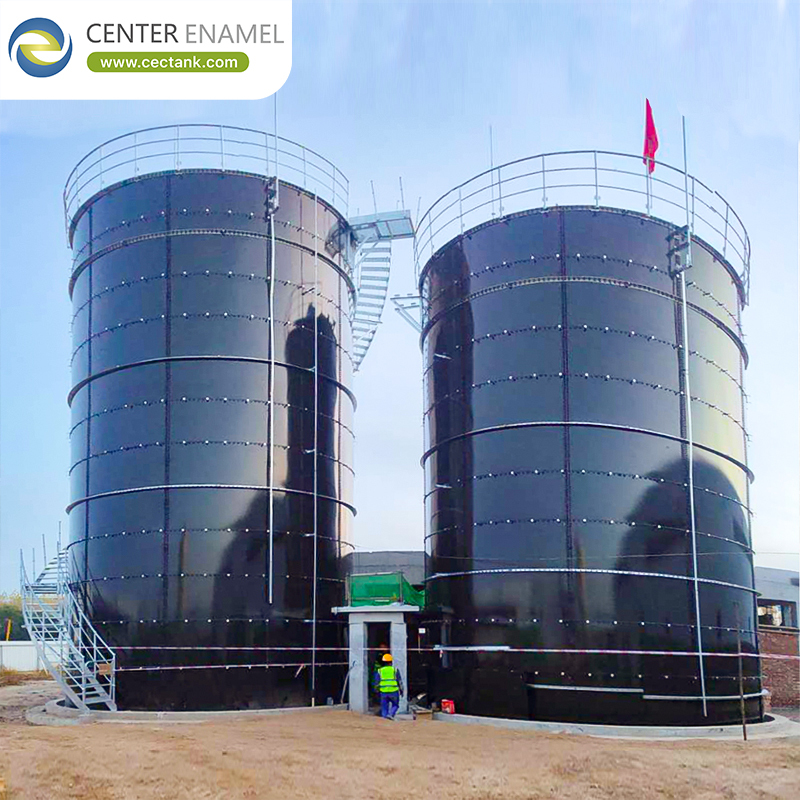
- Umfang: 2 massive GFS-Tanks, 16,82 x 23,4 Meter (H).
- Gesamtvolumen: 10.392 m³.
- Auswirkung: Seit 2023 in Betrieb, bewältigen diese Tanks extreme hydrostatische Drücke bei gleichzeitiger Aufrechterhaltung einer 100% dichten Integrität und dienen als globaler Maßstab für die Eindämmung von Schlamm und Sickerwasser.
5. FAQ: GFS vs. Beton für Schlammfaulbehälter
Wie geht GFS mit Schwefelwasserstoff (H₂S) um?
H₂S im Schlamm reagiert mit Feuchtigkeit zu Schwefelsäure, die Beton und Standardfarbe „auffrisst“. GFS ist eine anorganische Glasbarriere, die völlig immun gegen Säureangriffe ist und jahrzehntelang strukturelle Stabilität gewährleistet.
Ist die Installation schneller als bei Beton?
Ja. Da alle Paneele werkseitig vorgefertigt und vor Ort verschraubt werden, kann ein GFS-Tank inWochen, nicht Monateninstalliert werden. Es gibt keine Aushärtezeit und keine „Heißarbeiten“ (Schweißen), was in methanreichen Behandlungsbereichen entscheidend ist.
Was ist die maximale Kapazität?
Durch fortschrittliche Finite-Elemente-Analysen (FEA) entwickelt Center Enamel GFS-Tanks, die einzelne Kapazitäten von60.000 m³erreichen und damit die größte verschraubte Speicherlösung der Branche bieten.
Über Shijiazhuang Zhengzhong Technology (Center Enamel)
Mit über 30 Jahren Erfahrung und fast200 Patentenist Center Enamel der erste Hersteller in China, der beidseitige Emaillierungstechnologie entwickelt hat. Unsere GFS-Tanks sind in über 100 Ländern im Einsatz und erfüllen die strengsten internationalen Qualitäts- und Sicherheitsstandards.
Optimieren Sie noch heute Ihre kommunale Klärschlammbehandlungsstrategie.